
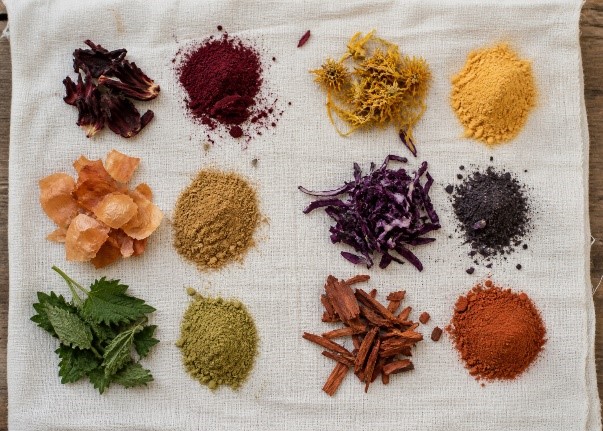
Long before modern industrialization, humanity looked to the natural world to add vibrant colour to their lives. The history of plant-dyed textiles is a fascinating journey of botanical exploration and human ingenuity, intertwining nature with the very fabric of human civilization.
The earliest evidence of natural dyeing dates back thousands of years. Archaeological discoveries in China, India, and Peru reveal dyed fabrics from over 5,000 years ago. Initially, early humans utilized a direct application method, simply rubbing crushed leaves, berries, and roots directly onto woven fibers. As civilizations evolved, so did their techniques. Ancient Egyptians mastered the use of safflower to dye the linen used in sacred mummy wrappings, while in India, the vibrant yellow of turmeric became a staple for both textiles and sacred religious ceremonies.
A breakthrough in plant dyeing was the discovery of mordants, such as mineral substances like alum or iron, that act as a fixative to create a permanent bridge between the plant pigment and the fiber. This discovery transformed fleeting botanical juices into enduring, lightfast colors. This era gave rise to the most valuable botanical dyes in history. Indigo, extracted from the leaves of the Indigofera plant, yielded deep, rich blues. Madder root provided a brilliant spectrum of enduring reds, while weld offered brilliant, sunny yellows. By skillfully overdyeing and combining these primary plant colors, artisans unlocked a vast, complex palette.
The demand for these vivid, plant-derived colors fueled global trade networks and shaped early economies. Caravans traversing the Silk Road carried bundles of brilliantly dyed silk and cotton, making colored fabrics a highly valuable commodity. In medieval Europe, certain plant-dyed colors became deeply associated with royalty and nobility, even dictating social hierarchies through strict sumptuary laws. Entire regions built their economic identities around specific botanical hues, with master dyists guarding their complex botanical recipes as closely guarded state secrets.
The nineteenth century brought a dramatic shift. In 1856, William Perkin accidentally synthesized mauveine from coal tar, birthing the synthetic dye industry. Synthetic dyes were cheaper, more consistent, and vastly easier to produce. Within decades, the ancient art of plant dyeing nearly vanished, relegated to rural artisans and historical footnotes as factories churned out brightly colored, mass-produced textiles.
Today, however, plant-dyed textiles are experiencing a powerful renaissance. Driven by growing environmental awareness and the toxic pollution associated with synthetic dyeing, designers and artisans are returning to botanical palettes. Modern natural dyers are reviving ancient techniques, embracing the subtle, earthy beauty of plant-based colours. This revival is more than a trend; it is a conscious return to sustainability, proving that nature’s original palette remains as relevant and beautiful as ever.
Thank you for reading!!
Also read:
Greenwashing vs Real Sustainability: What Consumers Must Know